Pages

Friday, December 2, 2011

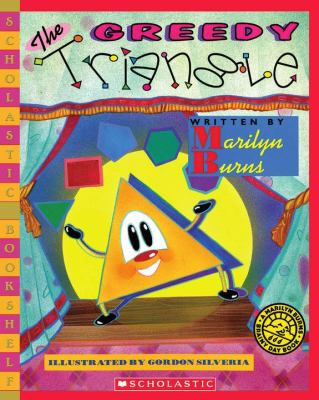
The Greedy Triangle

The Greedy Triangle
Written by: Marilyn Burns
Illustrated by: Gordon Silveria
Published by: Scholastic Inc. 1994
Grades: 1-3
Genre: Science Fiction, Math

Synopsis: This book tells the story of the greedy triangle.  After becoming bored with the triangle shape that he is, the shape shifter turns the triangle into other shapes.  This book tells the science of the types of shapes and incorporates magic behind the changing of the number of lines and angles it is made up of.   
Theme/Skill: Shape Knowledge, Change, Greed, Polygons, Geometry

About the Author: Marilyn Burns

Marilyn has taught children, led in-service workshops, written professional development publications for teachers and administrators, and has created staff development videotapes for more than 40 years.  She is the creator of Math Solutions Professional Development which is for Grades K-8 math instruction.  She continues to teach in the classroom to develop new testing ideas and materials to use.  She also is a published author and illustrator of children’s book including Spaghetti and Meatballs for All!, Greedy Triangle, About Teaching Mathematics: A K-8 Resource, and I Am Not a Short Adult. 
 Source used: http://teacher.scholastic.com/products/paperbacks/marilynburns/bio.htm

Pre-Reading Activities:  Hand each student a paper triangle and have them write down what they think a triangle is.  Ask questions such as:  What is your definition of a triangle?  How many lines does a triangle have?  How many angles does a triangle have? Go over a bunch of different shapes with the class by teaching them the number of lines and angles that each shape has.  This can be done by using the overhead or an elmo.


Post-Reading Activities:  Have the students make their own shapes out of different materials in the classroom.  They also will draw an object that has this shape, like a tv, a house, etc. and label it what shape it is.  They will use 2 sentences to describe what makes it that shape.  After they decorate them, hang them up around the classroom for the students to make reference to. 
Lesson ideas: http://www.mwpenn.com/lesson-plans/greedy-triangle/
Reflection:  This book is good for children who are starting to learn the polygons.  It is very informative and gives a lot of information for children to try to grasp if they have not already learned the name of the shapes.  It does make it fun for kids since it will not seem like they are learning rather that they are reading a fun book.  I love how it describes the different shapes but just doesn't use a solid form of it but rather examples that you would see in everyday life.  This will help them identify other ones that surround them everyday that they just have not noticed before.


Oh, The Places You'll Go!

Oh, the Places You’ll Go!
Written and Illustrated by: Dr. Seuss
Published by: Random House 1990
Grades: 2-6
Genre:  Poetry, Comedy, Classic

Synopsis: This is a poetry book that gives us a look at good fortunes and bad fortunes.  All of these fortunes could hit you in life in both a realistic and a fantasy sense.  The main character faces many challenges throughout it whether it be good or bad such as the grinning purple elephants, floating golden castles, or the deep blue wells of confusion.  The message he delivers is that life may be a “Great Balancing Act” but through it all “There’s fun to be done.”
Theme/Skill: Proceeding in life, Weather Fear, Loneliness, Confusion, Pride, Self-Esteem, Changes, New Experiences, Growing Up, and being in charge of your actions. It uses rhyming throughout the story.

About the Author and Illustrator: Dr. Seuss

Geisel was born in 1904 in Springfield, Massachusetts.  Theodor Seuss Geisel was known by many as his alias name, Dr. Seuss.  He came across this name his senior year at Dartmouth College when he was caught drinking gin in his room with his friends.  He was put on probation by the dean and no longer able to publish cartoons in the college’s magazine, Jack-O-Lantern.  To continue this, he began publishing cartoons under aliases.  When he became a magazine cartoonist he signed his work as Dr. Seuss.  After graduating from Dartmouth, Geisel studied literature at Oxford from 1925 to 1926.  He met his wife Helen Palmer there, and realized his real passion was drawing.  He went on to create ads for Flit and others including Holly Sugar, Ford, and General Electric.  The first book he wrote was And to Think That I Saw It on Mulberry Street in 1937.  He also wrote The Cat in the Hat, The 500 hats of Bartholomew Cubbins, Horton Hatches the Egg, Horton Hears a Who, and Green Eggs and Ham, among many others.    He married his second wife in 1968, Audrey Stone, after his first wife died.  Many of his books were influenced by her and his other encounters.  Seuss died on September 24, 1991 but continues to be an influence in children’s literature today.    


Pre-Reading Activities: Bring in two items, a good item and a bad item and place them behind two fake, poster board doors.  Have the students choose whether they want the item behind door #1 or door #2.  Ask why did you pick the door that you did?  Was it a guess or a good decision?  Talk about the difference between educated guesses, guesses in general, and good decisions. 

Post-Reading Activities:  Give each student a different scenario by having them pick which hand they want (this is a guess).  Give different scenarios such as a math problem where they can make an educated guess, a hard question where they need to guess, or a situation between people that will incorporate a good decision.  Have the students write down what method they used and why they decided on that method.  Have them each take turns sharing with the class. 

For more activities visit: http://seussville.com


Reflection:  I think all of Dr. Seuss' books are classics if you ask any individual about them.  His books use such imagination along with appeal to children through his rhyming schema and rhythm of words.  Also his appeal through his characters, the colors he uses, and the background on the pages draw children into reading.  I think this book in particular relates to children who are graduating, changing schools, or in general just developing and experiencing life.  It helps children understand that there will be good times and bad times, but through it all your life can be fun no matter what you do.  Dr. Seuss is such an inspiration that each teacher should use at least one of his books throughout their teaching career. 

Nine Days to Christmas


Nine Days to Christmas
Written by Marie Hall Ets and Aurora Labastida
Published by: The Biking Press 1987
Grades: 2-4

Genre:Multicultural, Picture Book
Award: Caldecott Medal

Synopsis: This book tells the story of a little girl Ceci and the Christmas tradition that she follows in Mexico.It tells about how she is now old enough to celebrate her first ever posada.In the nine days before Christmas, a party is given each night in the Mexican Christmas celebration. In the days leading up to the festival she gets to participate in many traditions.Ceci gets to pick out a piñata which will be used during the party.She chooses a star shaped one which she becomes to love.When it is time for her and her guests to break it she becomes dismayed and wants to leave her piñata the way it is.When the piñata breaks she is upset, but sees the real star that it turns into.The star turns out to be Ceci’s gift to the world.

Theme/Skill: Traditions, Mexico, Christmas, Family, Hispanic Heritage.Good things are worth waiting for.

About the Author: Marie Hall Ets

Marie Hall Ets was born in North Greenfield, Wisconsin.She went to college in Appleton, WI at Lawrence College and attended art institutions in Chicago, New York, and London.In November 1917, she married Milton Rodig.She worked as an artist after she moved to San Francisco.When her husband died a year later, she pursued a career as an author and illustrator of children’s books in the Midwest.In 1960, she won the Caldecott Medal for Nine Days to Christmas.She is also the author and illustrator of books including Play With Me, In the Forest, Just Me, andGilberto and the Wind.She passed away in 1984.

About the Author: Aurora Labastida

Information unable to be found.

Pre-Reading Activities: Bring in a piñata for the class to look at.Ask them when the use piñatas and what they associate it with.Have the students look at a map of Mexico and read about what posada are and why they use piñatas for them.Have the students write down three facts from what they read such as what are piñatas and where can you find them.


Post-Reading Activities: Students will write down what is at their Christmas party or any party that they have in general such as food and decorations. Then have them compare and contrast it to Ceci’s posada in a Venn Diagram to partner share when they are finished. Then create your own posada in class and fill the piñata you showed in the pre-reading activity. They can sing songs and play games to crack open the piñata.

Additional ideas to use: http://books.google.com/books?id=_Ifn-0yUkI8C&pg=PA87&lpg=PA87&dq=nine+days+to+christmas+summary&source=bl&ots=APhEzy-0EX&sig=5Jf5gcPJbHVdTJ1urrQ6XGDqyxo&hl=en&ei=12LZTtbRIcXe0QHv_uz2DQ&sa=X&oi=book_result&ct=result&resnum=4&ved=0CEQQ6AEwAw#v=onepage&q=nine%20days%20to%20christmas%20summary&f=false
Reflection: Although this book was published over 40 years ago, it still can be used in the classroom for a variety of things.  Although it is older, it still helps children learn about other cultures that are similar and different to theirs.  I think the illustrations help children follow along and capture the real essence of holiday traditions in Mexico.  I think that the most classic books that have been around for years are just as necessary as new and up to date books to use in the classroom.  Thus, using this book and then experiencing the traditions themselves in class will help them appreciate them more. 

Wednesday, November 30, 2011

Johnny Appleseed

Johnny Appleseed
Written and Illustrated by: Stephen Kellogg
Illustrated by:
Grades: K-4
Published by: Morrow Junior Books 1998
Genre: Biography, Nonfiction

Synopsis:  This book tells the story of a man named John Chapman, also known as Johnny Appleseed.  It is divided into nine short chapters that start with Johnny as a young boy.  He likes to play alone in the woods and read to the animals.  Mr. Crawford, a friend, teaches Johnny all about apples.  This book goes on to tell the infamous story of how he planted apple trees to get his nickname.  When he was 18, he went off and planted his own orchard.  He takes care of pioneers and entrusts them to plant the bag of apple seeds he gives them.  He then sets off to plant them on his own.  He does good deeds along the way helping those in need.  It then explains how tall tales are made up for him describing things he may have accomplished and tells who John Chapman is.
Theme/Skill: John Chapman, Agriculture, American History, Animals, Hospitality, Helping, Apple Trees.

About the Author and Illustrator:  Stephen Kellogg
Ever since Stephen was little he had a love for picture books and drawing.  He attended the Rhode Island School of Design and majored in illustration.  His senior year of college he was able to win a fellowship and study in Florence.  When he returned to the states, he completed graduate work at American University.  He began to submit picture books to publishers at this time as well.  He has published numerous books including A Hunting We Will Go, Is Your Mama a Llama, Yankee Doodle, and Paul Bunyen. 

Source used: http://www.stevenkellogg.com/index.html


Pre-Reading Activities:  Bring in an apple and brainstorm what comes to mind when they see the apple.  Ask what person this could be related to if no one mentions it.  Talk about John Chapman also known as Johnny Appleseed. 


Post-Reading Activities:  Make a poem together as a class about Johnny Appleseed recalling what happens throughout the book.  Look at different apples by bringing in different kinds and cutting into them.  Use this to help the children learn about the different kinds and the stages of growth during the seasons.  After you are done with discussion a good way to wrap up with a fun activity is to allow them to use the cut up apples to make apple stamps with paint to hang up around the classroom.  Also, this could be done around the time your class is going on a field trip to the apple orchard. 

Reflection:  This book is a classic that many teachers use.  I think this book would be great for teachers to use during the fall when apples are in season.  Children can learn about an American hero named John Chapman as well as apples and where and how they grow.  I think that this version of the story engages young readers through the picture book format which gives them brief text on each picture on the page.  I think that the illustrations in this book focus on the apples by making them the brightest objects on the page.  I think this helps keep the focus of the book, while readers hear about other things that Johnny Appleseed has done.  I like how at the end it tells who John Chapman is and puts the reality in the story.  I love this classic story that I think everyone has heard one time throughout their schooling. 

The Bus for Us

The Bus for Us
Written and Illustrated by: Suzanne Bloom
Grades: PK-1
Published by: Boyds Mills Press 2001

Genre: Fiction, Picture Book


Synopsis:  Tess waits with older friend Gus on her first day of school for the bus.  Tess has never seen a bus before and asks if every car that comes by is her bus.  There is a fire truck, ice cream truck, taxi, garbage truck, and many more that go by her.   She learns the names of the vehicles as she awaits her bus.
Theme/Skill: Transportation, School, Vehicles, Alterations in Words, Repetition.

About the Author: Suzanne Bloom 

Suzanne Bloom grew up in Portland, Oregon.  She then moved to New York City at the age of five and lived in a hotel until her family moved to an apartment in Queens.  She went to Cooper Union, an art school for college.   She became an illustrator and a writer.  In many of her works, she uses her children and items that she owns as inspirations for her illustrations and each book grows from a seed of truth.  She has published books including A Family for Jamie, The Bus for Us, My Special Day at Third Street School, and Girls, A-Z.   She has lived in Upstate New York for the past 25 years with her husband, two sons, and their cats and dogs. 
Source used:  www.suzannebloom.com

Pre-Reading Activities:  Have pictures of all different types of transportation all over the classroom for them to look at.  Talk about the transportation that we have and when we use transportation.  Ask questions such as:  What is transportation?  Have you ever been on a bus before?  What makes a bus different from a car?  What color is a bus?  Discuss with the class why we use different types of transportation.   
Post-Reading Activities:  On the board write all the ways that the kids are able to get around from place to place.  Then on a new piece of paper, write what makes a bus special.  Ask and list where the children have taken a bus before.  Then individually have students draw a picture of their favorite form of transportation and write a sentence or word depending on ability to describe it. 

Reflection:  I like the repetition this book uses.  It continually asks "Is this the bus for us, Gus?" as they are waiting for it.  It is a simple way for teachers to talk about transportation and the ways children and their parents get around.  The way it keeps using repetition makes it seem realistic since many children ask questions all the time, especially the same question multiple times.  Children are curious about things and it puts it in a perspective that they can understand.  The use of vibrant colors will attract children to the pictures and help them notice subtle differences in the words.  Even though some may not be able to read, they will notice the differences in pictures as the teacher turns the page.  Since it is repetitive in the book, having signs with jumbled wording will give kids something to look for and notice besides the new form of transportation that comes up.  The book also has unspoken things happen in it that the author does not address.  It has many more children come stand at the bus stop while the book progresses and has things happen to them that become unnoticed.  I do not see the purpose of this other than to have children be able to interpret what is happening without it being said.

Stellaluna

Stellaluna
Written and illustrated by: Janell Cannon
Grades:  2-4
Published by: Harcourt Brace and Company 1993
Genre:  Picture Book, Adventure

Synopsis:  This is a story about a bat named Stellaluna who was accidentally dropped by her mother.  She falls helplessly into a nest of birds whom they accept as long as she acts like a bird to not confuse the others.  Stellaluna tries to fit in but she wants to fly at night or hang upside down to sleep.  She only feels like the other birds when she is flying.  One day, she is discovered by another bat sleeping head up like she was taught by the birds.  Other bats are notified and Stellaluna is soon reunited with her mother.    she becomes friends withIn the end, Stelaluna reunited with her mother and remained friends with the birds who were different from her in many ways. 
Theme/Skill: Adventure, Nocturnal Animals, Individuality, Parents, Siblings, Friendship, Science

About the Author:   Janell Cannon
Janell was born in 1957 in St. Paul, Minnesota.  Janell has a love for animals including bats, spiders, dragons, and snakes.  She was a graphic artist for the Carlsbad Library where she designed and produced the summer reading programs.  She then became an author and illustrator.  She has written many books including Stellaluna, Verdi, Pinduli, Crickwing, and The Stories Julian Tells.  She currently lives in Southern California. 


Pre-Reading Activities:  Bring in a bird’s nest for the kids to observe and look at.  Ask questions such as:  What do birds eat?  Where do they live? Use gummy worms to show what birds eat and how this is different from what we eat.  Then turn off the lights and see if the children can see in the dark.  Then turn on the lights and ask questions such as:  Have you ever seen a bat before?  What do bats eat?  When do bats sleep?  How and where do they sleep?   


Post-Reading Activities:  Use a Venn Diagram chart on the overhead to have the children compare a bird’s life to the life of a bat.  This will be used as a concept map to compare and contrast.  They will first compare based on what they know from the book and then will spend time in the computer room and library to find differences and similarities to bring back to the class.  The Venn Diagram will be completed when the bring their papers back to class.  They will hand in a sheet of notes with their partner for the teacher to look at. 
More lesson ideas: http://www.lausd.k12.ca.us/lausd/offices/itd/cti/elementary/e_pc/pdf/word2/word2_lp.pdf


Reflection: I love the use of full page illustrations made from color pencils and acrylic. The depictions of the animals give them cahracter and make them look realistic. I think that the two pages included with facts about bats makes readers more intrigued to learn about this book and bats. I think that including this allows teachers to use this book in a variety of ways in the classroom. Teachers can talk from a science perspective and look at bats and birds like I did or take it from a different theme and look at friendship and family. I think that this story makes it easy for teachers to introduce different nocturnal animals and look at vocabulary words and lead into science experiments or factual information. It is really an engaging book.

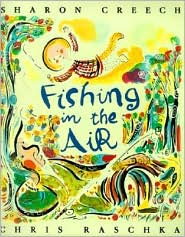
Fishing in the Air

Fishing in the Air
Written by: Sharon Creech
Illustrated by: Chris Raschka
Published by: Joanna Cutler Books 2000
Grades: K-3
Genre: Picture Book, Fiction, Poetry


Synopsis: This book is about a boy and his father who get up early to go fishing.  They set off on their trip hoping to “catch the air” and “catch the breeze.”  On their way, the father has his son use his imagination and turn the lamps into moons and the trees into soldiers.  At the river, the child “fishes” out of his father’s childhood:  finding out about his little gray house and its surroundings of green fields and a clear creek where he learned to fish.  At the end of the day, the father and son have not caught any fish, but they have caught so much more through the memories and the day and he has learned how to fish in the air like his dad. 
Theme/Skill: Fishing, Family, Imagination, Diversity.


About the Author: Sharon Creech

Sharon was born in South Euclid, Ohio and grew up surrounded by her sister and three brothers.  She often visited Quincy, Kentucky where her cousins lived.  This place that contained a farm with hills and trees helped her create many of her books including Walk Two Moons and Chasing Redbird and Bloomability.  In college, she took literature and writing courses which made her curious about story-telling.  She became a high school English and writing teacher in England and Switzerland.  Since then she has written adult novels and children’s literature.  Her first book published in the United States was Walk Two Moons which received the Newbery Medal.  She is currently married to Lyle Rigg and has two children, Rob and Karin. 


Pre-Reading Activities: In order to catch a fish, you need to use a fishing pole.  Start a discussion about fishing while letting the class look at the fishing pole you brought in.  Then show the class the cover and have them tell you what they think the story is about.  Then discuss with the class how and why people fish.  Some do it for recreation while others fish for something to eat.  Ask questions such as:  Have you ever been fishing?  Where you do you fish?  Have you ever caught anything?  Who do you go with?  Then explain that when you are fishing you may see different objects in the sky using your imagination.  Put on the board different cloud forms that can be interpreted into different objects and ask the kids what they think it is. 

For example clouds in the shape of animals:


Post-Reading Activities:  Talk about what the child found out about his house and what it looked like around it.  Then, have the children draw a picture of their house and the things that surround it.  Then, at home, have them ask their parents what their house looked like when they were little.  The children should draw what is described and bring it to the class to explain to everyone. 

Reflection:  I love the imagination this book brings out in students.  I think that it will give students more confidence in participating in class because images they see in pictures will not have any wrong answers because it is everyone's own opinion.  I think that the post-reading activity will also help children learn about what their families childhood was like and what they grew up in or with.  It will help them find out more about their parents and may help make them closer.  It helps show them what connects them to their family and will make them feel important when they share this information with their classmates.