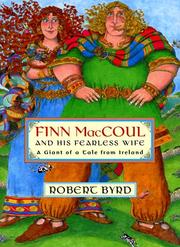
Finn MacCoul and His Fearless Wife: A Giant of a Tale from Ireland
Written and Illustrated by: Robert Byrd
Published by: Dutton Children's Books 1999
Grades: 2-4
Genre: Folklore
Published by: Dutton Children's Books 1999
Grades: 2-4
Genre: Folklore
Synopsis: This is an Irish folktale that tells the story of a giant named Finn MacCoul. Finn MacCoul, who can see the future, lives at the top of Knockmany Hill so he can keep an eye out on the Scottish bully, Cucullin. Since Finn is the tallest giant in Ireland and many think he is the most powerful, he becomes the target of Cucullin. Finn tells his wife, Oonagh, and together they must come up with a plan so he does not get beaten up. Oonagh devises a plan to have Finn pretend to be his own baby son when Cucullin comes. Finn is able to trick him as a result and make him powerless when he loses his golden finger, the source of his strength.
Theme/Skill: Ireland, Folklore, Finn MacCoul, Fear, Power, Outwit.
Message: Sometimes you can overcome something or someone without using your strength.
About the Author: Robert Boyd
"The most important thing is to have the small world I create in a picture perfectly match the words of the story, so that even if it is a make-believe world in the eyes and minds of the readers, everything you see is real."

Robert Byrd was born in Atlantic City, New Jersey. He studied at the Philadelphia Museum College of Art. He has been both an author and illustrator of many children’s books for over 30 years. He has illustrated over sixteen children’s books including Finn MacCoul and His Fearless Wife, The Bear and the Bird King, Leonardo, Saint Francis, Barbarians, and Kubla Khan. and many of his pieces of artwork have been displayed in many museums. He teaches Children’s Book illustration at The University of the Arts and Moore College of Art and Design in Philadelphia. He has a wife, two grown children and a cat. He currently resides in Haddonfield, New Jersey.
Source used: http://www.robertbyrdart.com/byrd/about.html
Pre-Reading Activities: Give children clues to a different riddle to get to the word “Folktale.” Ask students what a folktale is and where they come from. Put the correct definition of a folktale up on the board and tell how they usually have an underlying message in them.
Post Reading Activites: As a whole group, we will brainstorm what the underlying message of Finn MacCoul and His Fearless wife is. Then students will use the message to explain in a paragraph how it could be helpful to them someday. As an ongoing activity, the children can find their own folktale story to bring in to share with the class.
Reflection: love how this is a very comical story. It made me laugh as I read through it because you would never think that such a story would use such an event to overcome a situation. I think Byrd did a great job using humor to relay a message to the audience. Byrd uses his illustrations to capture the audience and keep them engaged as the story is a little lengthy. He doesn't make the words the focus of the page but rather the illustrations. He uses vibrant colors and has the picture take up the whole page without any white space. I think this story line will be good for children to learn about folklore and fables that are passed down in different cultures.
Post Reading Activites: As a whole group, we will brainstorm what the underlying message of Finn MacCoul and His Fearless wife is. Then students will use the message to explain in a paragraph how it could be helpful to them someday. As an ongoing activity, the children can find their own folktale story to bring in to share with the class.
Reflection: love how this is a very comical story. It made me laugh as I read through it because you would never think that such a story would use such an event to overcome a situation. I think Byrd did a great job using humor to relay a message to the audience. Byrd uses his illustrations to capture the audience and keep them engaged as the story is a little lengthy. He doesn't make the words the focus of the page but rather the illustrations. He uses vibrant colors and has the picture take up the whole page without any white space. I think this story line will be good for children to learn about folklore and fables that are passed down in different cultures.


