Pages

Showing posts with label Caldecott Medal Winner. Show all posts

Sunday, November 13, 2011

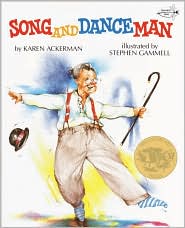
Song and Dance Man


Song and Dance Man
Written by: Karen Ackerman
Illustrated by: Stephen Gammell
Published: Dragon Fly Books 1992
Grades: 1-3

Genre: Children’s literature, Realistic fiction, Picture BookAwards: Caldecott Medal 1989

Synopsis: It is a story that takes place in the attic of the grandfather of three children.  He takes them up there to entertain them while they await dinner.   Their grandfather is seen as the song and dance man, when he uses his imagination to have fun with his grandchildren in the attic.  The children put on hats and pretend to dance like they are on stage too.  Grandpa demonstrates some of the songs, dances, and jokes he performed when he was a vaudeville entertainer.  All of the children cheer with laughter and beg him to do more.  But in the end, grandpa would never trade his days back then for what he has now.
Theme/Skill: Performing Arts, Family

About the Author: Karen Ackerman
Karen was born in Cincinnati, Ohio in 1951.  She graduated from Woodward High School.  She is known as an American author of over 25 children’s books.  Her first book was published in 1982.  The book above mentioned, Song and Dance, won the 1989 Caldecott Medal.  She is also credited for the books Flannery Row, I Know a Place, Moveable Mabeline, The Night Crossing, and This Old House. 

For more information visit:  http://www.juggle.com/karen-ackerman
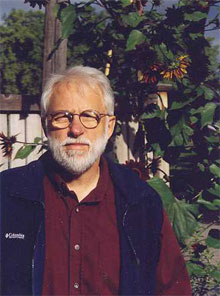
About the Illustrator: Stephen Gammell
Gammell grew up in Des Moines, Iowa.  He was given inspiration to be an artist from the periodicals his father brought home from his magazine.  He worked in commercial freelance until he became interested in children’s book illustrations.  He is known for his illustrations in books including, Scary Stories to tell in the Dark, More Scary Stories to Tell in the Dark, Scary Stories 3, Where the Buffaloes Begin, and Song and Dance.  He received the Caldecott Medal for his book Song and Dance as well as Where the Buffaloes Begin, and The Relatives Came.  He lives with his wife in St. Paul, Minnesota.

Source used: http://www.jacketflap.com/stephen-gammell/145693
Pre-Reading Activities: Students will close their eyes and scribble on paper while thinking in their mind of anything using their imagination.  After they are given a couple minutes, students will come back together.  We will discuss the word imagination and then we will make a web chart of when we use our imaginations and the feelings they create inside of us.

Post-Reading Activities:  After the book we will come together as a class and discuss how the grandfather and the children in the story used their imagination and also how it made them feel.  Students will then take their scribble papers from prior to reading and switch with a partner.  The students will look at the scribbles and use their imaginations to color in different parts of the scribble to make a picture and how it makes them feel.  They will then share with the class. 

Reflection:  This book received a Caldecott Medal for many reasons. I love books that have illustrations that help illuminate the story. The story line goes hand and hand with the pictures and is good for readers who need context clues to help them decipher words. The story helps the audience use their imagination and show how people can have fun with the most simple things. I love how its from the children's perspective and allows them to see their grandpa or elders in a different light. 


Sunday, October 23, 2011

The Lion and The Mouse

The Lion and The Mouse
Written and Illustrated By: Jerry Pinkney
Published by: Little, Brown Books for Young Readers 2009
Grades: PK-2
Genre: Fables, Folkore, Stories without Words
2010 Caldecott Medal Winner

Synopsis:
This book is based on the Aesop fable, “The Lion and the Mouse.”  This book is a wordless version of the fable which uses only little animal sounds such as “Rrrr”, “Squeak, Squeak, Squeak” and “Who.”  The illustrations depict the fable where a mouse accidently disturbs a lion from his rest and is in the grasp of the lion.  The lion decides to release his prey and let him go leaving the mouse devoted to him.  Later on the lion falls into a trap and the mouse remembers his debt to the lion.  The mouse goes and frees the lion from the poacher’s trap as a result.  The mouse proves that even small creatures are capable of great deeds.  The illustrations use full-color artwork using pencil, watercolor and colored pencils on paper. 

Theme/Skill: It carries the message of how the meek can trump the mighty. It allows children to use their imagination and context clues of the pictures to tell the story and what happens in it.

About the Author and Illustrator:  Jerry Pinkney
Jerry Pinkney grew up in Philadelphia, Pennsylvania and is one of six children.  At age four or five, Jerry started drawing and loved the compliments and attention he would get from it.  He was never a good reader or adept speller, but drawing helped him build confidence.  He attended an all-black elementary where he learned a tremendous amount about his culture.  He attended Dobbins Vocational High School where he began his formal art training.  When he graduated he received a scholarship to the Philadelphia Museum College of Art.  His work today is influenced greatly by Charles White, Romare Bearden, and Jacob Lawrence, all African American artists.  When completing his illustrations, he uses models and takes photos of them to reference body language and facial expressions, and keeps hundreds of books on nature and animals as references.  Pinkney has illustrated over one hundred books since 1964.  He has received five Coretta Scott King Award and four Coretta Scott King honors.  books including The Ugly Duckling, John Henry, The Nightingale, Noah’s Ark, and Twinkle, Twinkle, Little Star.  His illustrations for The Lion & The Mouse received the Caldecott Medal in 2010.  He currently lives with his wife, Gloria Jean, in Westchester County, NY. 


Pre-Reading Activities:  Show the cover of the book:  Tell the children that this book is based on Aesop's fable.  Read them the fable so they have the background knowledge of what is going to happen.  Ask student's what they think the message of the book is, if they do not, say something along the lines of: "That sometimes even the smallest person can help you out and be your friend."

Aesop's Fable

Then tell the children that the book we are going to look at is different from most books, it has no words in the book, but rather tells a story through their pictures.  Children will take turns telling the story of what is happening in each picture.  The teacher will remind them of Aesop's fable and keep them on track with the story as they go through each picture. 

Post-Reading Activities:  Ask children what they had to use to tell the story if there were no words?  Have them brainstorm what they used.  Then give each child a different page from the book that is copied.  Tell them to come up with at least 2 sentences to go along with the picture.  They can use the word wall to help them write certain words and if they do not know how to spell a word they can sound it out.  When they are done, they will bring it to the teacher for approval.  If they are finished and given permisson they can choose one of the coloring pages from below to color while the others finish. 

Mouse coloring page
Lion coloring page

Reflection: The illustrations of this book are outstanding.  The colors used just accentuate the pictures so much and allow readers to focus in on them.  The pictures do an excellent job telling the story since it is a wordless book.  It does include some animal noises at times to show the emphasis of the animals and the strengths or weaknesses that they have.  I think this book is good for children who are just starting to become readers and for others who are learning to focus on the comprehension of stories.  For beginning readers, since it does not have words it does not intimidate them and steer them away from using their imaginations.  It doesn't have them become frustrated trying to figure out words.  For those learning to focus on comprehension, it helps those students learn that pictures can be clues of what the story is about and allow readers to use them as references when deciphering words in other books.