Pages

Showing posts with label Poetry. Show all posts

Friday, December 2, 2011

Oh, The Places You'll Go!

Oh, the Places You’ll Go!
Written and Illustrated by: Dr. Seuss
Published by: Random House 1990
Grades: 2-6
Genre:  Poetry, Comedy, Classic

Synopsis: This is a poetry book that gives us a look at good fortunes and bad fortunes.  All of these fortunes could hit you in life in both a realistic and a fantasy sense.  The main character faces many challenges throughout it whether it be good or bad such as the grinning purple elephants, floating golden castles, or the deep blue wells of confusion.  The message he delivers is that life may be a “Great Balancing Act” but through it all “There’s fun to be done.”
Theme/Skill: Proceeding in life, Weather Fear, Loneliness, Confusion, Pride, Self-Esteem, Changes, New Experiences, Growing Up, and being in charge of your actions. It uses rhyming throughout the story.

About the Author and Illustrator: Dr. Seuss

Geisel was born in 1904 in Springfield, Massachusetts.  Theodor Seuss Geisel was known by many as his alias name, Dr. Seuss.  He came across this name his senior year at Dartmouth College when he was caught drinking gin in his room with his friends.  He was put on probation by the dean and no longer able to publish cartoons in the college’s magazine, Jack-O-Lantern.  To continue this, he began publishing cartoons under aliases.  When he became a magazine cartoonist he signed his work as Dr. Seuss.  After graduating from Dartmouth, Geisel studied literature at Oxford from 1925 to 1926.  He met his wife Helen Palmer there, and realized his real passion was drawing.  He went on to create ads for Flit and others including Holly Sugar, Ford, and General Electric.  The first book he wrote was And to Think That I Saw It on Mulberry Street in 1937.  He also wrote The Cat in the Hat, The 500 hats of Bartholomew Cubbins, Horton Hatches the Egg, Horton Hears a Who, and Green Eggs and Ham, among many others.    He married his second wife in 1968, Audrey Stone, after his first wife died.  Many of his books were influenced by her and his other encounters.  Seuss died on September 24, 1991 but continues to be an influence in children’s literature today.    


Pre-Reading Activities: Bring in two items, a good item and a bad item and place them behind two fake, poster board doors.  Have the students choose whether they want the item behind door #1 or door #2.  Ask why did you pick the door that you did?  Was it a guess or a good decision?  Talk about the difference between educated guesses, guesses in general, and good decisions. 

Post-Reading Activities:  Give each student a different scenario by having them pick which hand they want (this is a guess).  Give different scenarios such as a math problem where they can make an educated guess, a hard question where they need to guess, or a situation between people that will incorporate a good decision.  Have the students write down what method they used and why they decided on that method.  Have them each take turns sharing with the class. 

For more activities visit: http://seussville.com


Reflection:  I think all of Dr. Seuss' books are classics if you ask any individual about them.  His books use such imagination along with appeal to children through his rhyming schema and rhythm of words.  Also his appeal through his characters, the colors he uses, and the background on the pages draw children into reading.  I think this book in particular relates to children who are graduating, changing schools, or in general just developing and experiencing life.  It helps children understand that there will be good times and bad times, but through it all your life can be fun no matter what you do.  Dr. Seuss is such an inspiration that each teacher should use at least one of his books throughout their teaching career. 

Wednesday, November 30, 2011

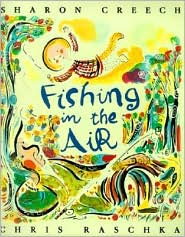
Fishing in the Air

Fishing in the Air
Written by: Sharon Creech
Illustrated by: Chris Raschka
Published by: Joanna Cutler Books 2000
Grades: K-3
Genre: Picture Book, Fiction, Poetry


Synopsis: This book is about a boy and his father who get up early to go fishing.  They set off on their trip hoping to “catch the air” and “catch the breeze.”  On their way, the father has his son use his imagination and turn the lamps into moons and the trees into soldiers.  At the river, the child “fishes” out of his father’s childhood:  finding out about his little gray house and its surroundings of green fields and a clear creek where he learned to fish.  At the end of the day, the father and son have not caught any fish, but they have caught so much more through the memories and the day and he has learned how to fish in the air like his dad. 
Theme/Skill: Fishing, Family, Imagination, Diversity.


About the Author: Sharon Creech

Sharon was born in South Euclid, Ohio and grew up surrounded by her sister and three brothers.  She often visited Quincy, Kentucky where her cousins lived.  This place that contained a farm with hills and trees helped her create many of her books including Walk Two Moons and Chasing Redbird and Bloomability.  In college, she took literature and writing courses which made her curious about story-telling.  She became a high school English and writing teacher in England and Switzerland.  Since then she has written adult novels and children’s literature.  Her first book published in the United States was Walk Two Moons which received the Newbery Medal.  She is currently married to Lyle Rigg and has two children, Rob and Karin. 


Pre-Reading Activities: In order to catch a fish, you need to use a fishing pole.  Start a discussion about fishing while letting the class look at the fishing pole you brought in.  Then show the class the cover and have them tell you what they think the story is about.  Then discuss with the class how and why people fish.  Some do it for recreation while others fish for something to eat.  Ask questions such as:  Have you ever been fishing?  Where you do you fish?  Have you ever caught anything?  Who do you go with?  Then explain that when you are fishing you may see different objects in the sky using your imagination.  Put on the board different cloud forms that can be interpreted into different objects and ask the kids what they think it is. 

For example clouds in the shape of animals:


Post-Reading Activities:  Talk about what the child found out about his house and what it looked like around it.  Then, have the children draw a picture of their house and the things that surround it.  Then, at home, have them ask their parents what their house looked like when they were little.  The children should draw what is described and bring it to the class to explain to everyone. 

Reflection:  I love the imagination this book brings out in students.  I think that it will give students more confidence in participating in class because images they see in pictures will not have any wrong answers because it is everyone's own opinion.  I think that the post-reading activity will also help children learn about what their families childhood was like and what they grew up in or with.  It will help them find out more about their parents and may help make them closer.  It helps show them what connects them to their family and will make them feel important when they share this information with their classmates.

Tuesday, November 15, 2011

Red Sings from Treetops: A Year in Colors

Red Sings from the Treetops
Written by: Joyce Sidman
Illustrated by: Pamela Zagarenski
Published by: Houghton Mifflin Harcourt 2009
Grades: PK-2
Genre: Picture Book, Poetry
Caldecott Honor Book

Synopsis: This book travels through each season and describes the colors that you see throughout it. It starts with spring and ends full circle with spring again with the color red. In this book, it associates spring with red and the red cardinals that appear singing and the buds of the leaves too. It talks about the green that covers the earth on the trees and in the grass. It talks about birds being born and how spring is also the new beginning to things. It then leads into summer and talks about yellow and the sun and how it melts everything it touches. It then goes into fall where it talks about green being tired and how brown rises and takes over. It ends in winter when you breathe blue and white traces all over everything. It ends with red and the inclination that spring will be here again with the cardinals singing. This completes the cycle of the seasons.
Theme/Skill: Seasons, Colors, Figurative Language, Poetry, Descriptive Language, Word Recognition
About the Author: Joyce Sidman
Joyce Sidman was born in Connecticut and has three sisters.  Education was an important aspect to her parents and herself as she was growing up.  She began writing in grade school by writing things down that came in her head to help her understand the world.  She discovered her love for poetry in high school from the inspiration of one of her teachers.  She loves using images and metaphors in her poetry to explain her thoughts and feelings.  She has written almost one hundred books, but currently has eleven children’s books that have been published.  Among these are Swirl by Swirl: Spirals in Nature, Dark Emperor, The World According to Dog, and Red Sings from Treetops: A Year in Colors.  The latter book received the Caldecott Honor in 2010.  She currently lives in Minnesota with her husband and two sons. 

Source used: http://www.joycesidman.com/biography.html

About the Illustrator:  Pamela Zagarenski
Pamela Zagarenski  graduated from the University of Connecticut with a BFA in Graphic Design.  She is well known as a published illustrator of thirteen children’s books.  Among these books are What Day Is It?/ Que Dia Es?, This Is Just to Say: Poems of Apology and Forgiveness, Mites to Mastodons: A Book of Animal Poems, Small and Large, and Red sings from Treetops: A Year in Colors.   Pamela is also known for her paintings that are on display in the Whyevernot Gallery in Mystic.  She currently lives in Stonington, Connecticut. 


Pre-reading Activities: Activating Prior Knowledge:  Break the students up into four gropus.  In their groups, give students a piece of chart paper, markers, colored pencils, and crayons.  Each group will receive a season as their topic: fall, winter, spring, or summer.  Tell students that their job in the group is to come up with a scene that represents the season their group was given.  When they are done, they need to present it to the rest of the class and explain why they chose the colors they did. 

Post-Reading Activities:  Following reading the book, students will again take their season that they had in the pre-reading activity.  Each student will create their own poem about the season they had first.  They can use the same picture from their chart to help write their poem or create another picture that they will use to describe their poem.  In their poem they must include at least two colors.  These colors must use the same strategy as in the book and have them highlighted in their color.  The poems must be at least 5-7 lines.  Students will have time to start these in class.  If they do not finish in the class time they will take them home to finish and bring them back the next day.  Students will then share them with a partner and have them edit their poem or give them ideas on how to fix them.  After this is done, they will then write a final draft and place it on the final paper with their picture.  They will share it with the class and then each poem will be used to create a class season poem book to put in the reading area. 


Reflection:  I think this book allows children to learn about the seasons both visually and auditorally. It not only allows children to learn their seasons but also their colors. While following along it writes the name of the color in that color. The pages make the color it speaks about pop out and allows children to pick out the different things the story is talking about. I think this book is especially good for visual learners who need pictures in front of them to be able to understand what the teacher is talking about. The rhythm of the book makes a nice read and easy for children to follow along. The book is lengthier than others but using intonation and questions throughout the story should keep students engaged throughout the entire story.

Sunday, October 23, 2011

All the World

All the World
Written by:  Liz Garton Scanlon
Illustrated by: Marla Frazee
Published by: Beach Lane Books 2009
Grade Levels: K-2
Genre: Poetry, Picture Book
2010 Caldecott Medal Honor Book
Synopsis: This book follows a brother and a sister through the day and night starting at the beach. It takes them on a summer day from building sandcastles to going to the farmers market, on a walk, a pavilion, getting soaked in the rain, to a cafe, to home where the fire is on, people dance and sing, and they settle for bed just like you and me. The family in this book experience many diverse situations as they encounter different aspects of the world. It allows readers to appreciate different aspects of the world, including night and day, warm, cold, rain or shine, etc. and shows readers that they are a part of the world in every way. 

Theme/Skill: World, Human Kind, We are part of the Universe.It uses rhyming couplets and it makes connections between words and images.

About the Author: Liz Garton Scanlon
Elizabeth Garton-Scanlon, known by many as Liz, grew up in Colorado and Wisconsin.  She is well known as an author and a teacher.  She is the author of books such as, A Sock is a Pocket For Your Toes, Noodle and Lou, and All the World, a Caldecott Honor Book in 2010.  Liz loves Mexican food, hiking, and live music.  She currently is an adjunct professor of creative writing at Austin Community College and lives with her family in Austin, Texas. 


Pre-Reading Activities:  Brainstorm a list of things that children do on the weekend and record them on sentence strips.  Then after each child has answered and the sentence strips are placed on the board, allow children to come up one by one and place their strip under one of the categories, either activities that cost money or things that don't. 

Lead into the book, by telling students to play close attention as you walk through the book to see if any of their activities they do are also in the book.  First do a picture walk through of the book.  Point out on the cover, the title, author, and illustrator.  Have students brainstorm what they think the book is about just by hearing the title and seeing what illustrations are on it.  Then as you go through the pictures in the book, ask students if they have done any of the activities in teh book or if they have mentioned any of these already in our sort.  Then read the book out loud to the whole-group. 
 
Post-Reading Activities: 


This book will be used as the main focus of different centers for that day.  There will be three centers, one guided by the teacher and the other two that are independently run by the students.  The teacher will first explain all the centers and make sure students understand before having them go off on their own. 

Activity 1:  Teacher led:  Have the children have individual books to read.  We will look at different pages and have the children sound out the words and follow along as other children read.  “All the world’s a garden bed.”  “Everything you hear, smell, see,..”  We will go more in depth of what each page is asking.  We will look at the five senses and see what we hear, smell, see, taste, touch if we were in this picture.  We will also use our own example such as lunch time and divide things up into each sense by making a chart.   During this time we will look at the five senses but also practice decoding and fluency of material for the students in the group. 

Activity 2:  Independently run: Students will cut out words and sort them under each sound that it goes with.  The sounds the words will be sorted into will be: -ing, -s, -ll.  They will go back through the book and look for words that end with these.  Then they will have a piece of paper with pictures and words that end with these and they will have to cut them up and sort them under the column as well if they have time. 

Activity 3:  Independently Run:  Children will color a picture of a boy or girl to represent themselves.  They will cut this out of themselves and write across their shirt one way they show love.  An aid will be there to help them sound out what they want to say.  These pictures will be placed around a huge earth that will be placed on the bulletin that will say:  “All the World is All of Us.” –by Liz Garton Scanlon, We “Show Love in All Different Ways!”


Reflection:  I love the use of the watercolors and black Prismacolor pencil throughout the book in the illustrations.I think that using a white background as the canvas makes readers focus on the illustrations at hand and look at every single one as the words are being read. I like how the illustrations follow along with the words and allow young readers who are just beginning to learn how to read learn to follow along and eventually be able to read it by themselves. Even if they are unable to read they can create a story that is similar to the one presented by looking at the pictures.