Pages

Showing posts with label Picture Book. Show all posts

Friday, December 2, 2011

Max Learns Sign Language


Max Learns Sign Language Written by: Adria Klein
Illustrated by: Mernie Gallagher-Cole
Published by: Picture Window Books 2007
Grades: K-1
Genre: People with Disabilities, Picture Book


Synopsis: A young boy named Max, wants to be able to talk with his friend, Susan, who can’t hear.  So he can talk to her, he takes a sign language class where he learns different words like hello so he can talk to Susan about things. 

Theme/Skill:  Sign Language, Deafness, Friendship.  It shows signs throughout the book that children could learn.

About the Author: Adria Klein


Adria has written books, book chapters, and articles dealing with emergent literacy.  She is the author of a series of children’s books about Max including: Max Learns Sign Language, Max Stays Overnight, Max Goes to the Library, Max Goes to the Zoo, and Max Goes to the Playground.  She is the co-editor of Literacy, Teaching, and Learning, a journal of the Reading Recovery Council of North America.  She is currently a professor at California State University in the Department of Educational Research and Policy.  There she teaches language arts and literacy courses in the graduate Reading Education program. 


Source used: http://www.scholastic.com/teachers/contributor/adria-f-klein
Pre-Reading Activities:  Before the book is read, put a list of words that are found in the book.  Make a list of them on your writing board for children to see.  Words that should be included in this are friend, Max, sign, hello, learn , language.  For a warm up, say the word and then sound out the word with the children using the weightlifting technique.  All of the children lay on the rug and as the teacher says the letter, the children will “bench” the letter and repeat the letter after the teacher until the whole word is complete.  This will help to familiarize the kids with the words in the book they will listen to and eventually read independently. 
                                                                  

Throughout the book and after ask questions of the students including:  Why does Max want to learn sign language?  What can we use sign language for?  What happened in the story?

Post-Reading Activities:  Have the children draw a picture that creates a summary of the book.  Then have them write a sentence by sounding it out and using the board of the words from the book.  Then when they are done, teach them some simple signs to communicate with one another.  Have them practice the sign by making it to their partner who sits across or next to them. 

Writing Page: http://mrsjonesroom.com/pix/story_paper.jpg


Signs: http://www.lifeprint.com/asl101/pages-layout/concepts.htm

Reflection:  I think that this book is for very beginning readers and must be used for very young children.  The book contains one sentence on the pages to go along with the pictures in the story.  It is meant for children to learn to start to read this book and be able to do it on their own.  I think that this book could be used in guided reading for children to practice on their own as well as in whole group where teachers can introduce sign language to them to use in their class.  I like how the book tries to show a few signs throughout the book, but it is difficult to see exactly how to make the sign just from the picture.  Additional research on signs would have to be done in order to make the sign correctly.  

Moses Goes to a Concert


Moses Goes to a Concert
Written and Illustrated by: Isaac Millman
Published by: Farar, Straus, & Giroux 2002
Grades: K-3
Genre: Realistic Fiction, Disabilities

Synopsis: A young boy named Moses and his friends at school are deaf.  They attend a school field trip with their class and their teacher Mr. Samuels to a concert.  On the trip they meet, Marjorie Elwyn who plays the drums.  The class learns that she is deaf too.  At the concert they watch her perform and can feel the music through the balloons Mr. Samuels gives them.  At the end of the concert, the children find out that they get to play Marjorie’s instruments.  They learn from her that you can do anything if you set your mind to it, no matter who you are.  Throughout the book there are pictures of signs to go along with some words.  At the end of the book there are conversations in sign language and the sign alphabet. 

Theme/Skill:  Deaf, Instruments, Sign Language, Hearing, Disabilities, Values, Diversity.  It uses sign language throughout the book for children to learn.

About the Author: Isaac Millman
Isaac was born in France in 1933 and came to the United States when he was a teenager after his parents were killed from the German occupation in France.  In 1948, when he came to the United States, he was adopted by an American Jewish Family in Brooklyn, NY.  He later on became a United States citizen and served in the armed forces.  He attended college at Pratt Institute where he graded with a degree in fine arts in 1952.  He also worked as a senior art director for a large sales promotion agency.  Isaac is known as both an author and illustrator of several books including four Moses books, Hidden Child, and Arbeit macht Freit-Work Sets You Free.  He currently lives in New York City with his wife and has two sons. 

Source used: http://isaacmillman.com/Author/Bio.html

Pre-Reading Activities: As a whole-class, the students will make a list on the board of the field trips they have taken.  Ask questions such as:  What field trips have you taken?  Which one did you like best? What was so special about the trip?  After creating this list, add going to a concert.  Ask students: Why would they want to go to a concert?  What would you like about it? What do you see and hear at a concert?  Then lead into discussion about hearing.  What if you couldn’t hear but still wanted to go to a concert?  Would you go?  Explain that many people who are hearing impaired still go to concerts but rather listen for different things besides the words, they listen for the vibrations of sound to figure out the words.  Play a tape for them and have them wear earphones so they hear the vibrations rather than the words.  Ask them to make a chart about what they experienced.  Then read the book.

Post-Reading Activities: Have children learn some sign language.  Explain that although Moses and his friends are deaf, they can still communicate with others just like we do except they sign to communicate.  Teach them some signs such as please, thank you, I want, I need, colors, letters, etc.  Whichever signs would be most helpful in the classroom.  Give them pictures of these signs and have them go home and practice them.  Have them create a sentence at home that consists of five words.  Have them learn the signs and share it with the class the next day.  Continue using sign language in your class so students will pick up on it and may use to communicate with you and other students. 
Lesson Ideas: http://www.smbsd.org/uploaded/reading/files/Grade_2_Theme_6_Sel_2_Moses_Goes_Concert_headings.pdf
http://www.lessonplanspage.com/mdlamathssmusicartdeafnessandsignlanguageunit24-htm-2

Sign Language Game: http://www.funbrain.com/signs/index.html
Reflection:  Although this book is written a little over ten years ago, I loved this book more than recent ones that I found on the hearing impaired.  I think the story does a great job showing kids that those who are hearing impaired can do everything that we do like even go to music concerts.  It follows the children on a class field trip and portrays them to the audience like they have no disability.  They still communicate with one another and listen to the instruments but just in different ways through sign and through hearing the vibrations.  I love how the book illustrates the different signs that go with words on the page and show the audience how to do it.  I love this idea because then you can learn some sign language and maybe inspire people to go take a class on it to someday use.  I am absolutely in love with this book! 

The Very Hungry Caterpillar

The Very Hungry Caterpillar
Written and Illustrated by: Eric Carle
Published by: Philomel Books 1987

Grades: K-2
Genre: Picture Book, Classic, Math

Synopsis: This story tells about the transformation of a very hungry caterpillar into a beautiful butterfly.  The caterpillar eats his way through numerous foods in large amounts including, candy, pie, apples, pears, cupcakes, etc. until he becomes full at last.  He then forms a cocoon around himself and falls asleep until he one day breaks through as a butterfly. 

Theme/Skill: Counting and Numbers, Life Cycles, Caterpillars, Butterflies, Story Sequencing.

About the Author: Eric Carle

Eric was born in 1929 in Syracuse, New York.  When he was six, he moved to Germany with his family where he became educated and graduated from Akademie der bildenden Kunste, a prestigious art school.  In 1952, he returned to America with his portfolio and settled in New York.  He found a job as a graphic designer for the New York Times.  He was asked one day by Bill Martin, Jr. to illustrate a book he had written.  As a result was the publication of the book, Brown Bear, Brown Bear, What Do You See?  This started Carle’s career as an illustrator.  His most famous work is the Very Hungry Caterpillar published in 1969.  Since then he has illustrated more than seventy books.  Today Carle, has two grown children and divides his time with his wife in the Florida Keys and North Carolina. 

Source used: http://www.eric-carle.com/bio.html

Pre-Reading Activities:  Bring in a few caterpillars for the children to look at.  Ask questions such as: What is one thing you noticed about the caterpillars?  Where do you think you find caterpillars? What do caterpillars turn into?  On the board, go through the different stages of a caterpillar turning into a butterfly.  Have a different student come up to the board to write out each different stage.  

Post-Reading Activities:  Group the students by having them count off by threes.  Have each group make either a caterpillar, cocoon, or butterfly.  The finished products will be hung from the ceiling as the class maps out the different stages of development.  Also keep the live caterpillars in the classroom to observe each day to watch it change and chart how long it stays in each stage. 

Lesson Ideas: http://www.dltk-teach.com/books/hungrycaterpillar/index.htm
Reflection:  I remember reading this book while I was little.  Now that I have read it to my preschool children, it seems to never get old with whichever generation reads it.  Both the preschool children and myself love the vibrant and colorful illustrations that fill each page.  Having a white background with large images that pop out of the pages draws your eye onto each page.  I love how there are holes through the food to show that a caterpillar has eaten through it.  The concept of the book is so simple yet helps children see how a caterpillar changes and helps them learn how to count the number of objects plus learn the days of the week.  Spectacular!

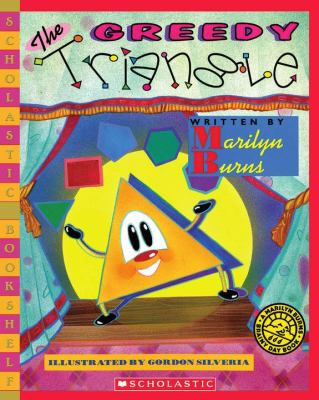
The Greedy Triangle

The Greedy Triangle
Written by: Marilyn Burns
Illustrated by: Gordon Silveria
Published by: Scholastic Inc. 1994
Grades: 1-3
Genre: Science Fiction, Math

Synopsis: This book tells the story of the greedy triangle.  After becoming bored with the triangle shape that he is, the shape shifter turns the triangle into other shapes.  This book tells the science of the types of shapes and incorporates magic behind the changing of the number of lines and angles it is made up of.   
Theme/Skill: Shape Knowledge, Change, Greed, Polygons, Geometry

About the Author: Marilyn Burns

Marilyn has taught children, led in-service workshops, written professional development publications for teachers and administrators, and has created staff development videotapes for more than 40 years.  She is the creator of Math Solutions Professional Development which is for Grades K-8 math instruction.  She continues to teach in the classroom to develop new testing ideas and materials to use.  She also is a published author and illustrator of children’s book including Spaghetti and Meatballs for All!, Greedy Triangle, About Teaching Mathematics: A K-8 Resource, and I Am Not a Short Adult. 
 Source used: http://teacher.scholastic.com/products/paperbacks/marilynburns/bio.htm

Pre-Reading Activities:  Hand each student a paper triangle and have them write down what they think a triangle is.  Ask questions such as:  What is your definition of a triangle?  How many lines does a triangle have?  How many angles does a triangle have? Go over a bunch of different shapes with the class by teaching them the number of lines and angles that each shape has.  This can be done by using the overhead or an elmo.


Post-Reading Activities:  Have the students make their own shapes out of different materials in the classroom.  They also will draw an object that has this shape, like a tv, a house, etc. and label it what shape it is.  They will use 2 sentences to describe what makes it that shape.  After they decorate them, hang them up around the classroom for the students to make reference to. 
Lesson ideas: http://www.mwpenn.com/lesson-plans/greedy-triangle/
Reflection:  This book is good for children who are starting to learn the polygons.  It is very informative and gives a lot of information for children to try to grasp if they have not already learned the name of the shapes.  It does make it fun for kids since it will not seem like they are learning rather that they are reading a fun book.  I love how it describes the different shapes but just doesn't use a solid form of it but rather examples that you would see in everyday life.  This will help them identify other ones that surround them everyday that they just have not noticed before.


Nine Days to Christmas


Nine Days to Christmas
Written by Marie Hall Ets and Aurora Labastida
Published by: The Biking Press 1987
Grades: 2-4

Genre:Multicultural, Picture Book
Award: Caldecott Medal

Synopsis: This book tells the story of a little girl Ceci and the Christmas tradition that she follows in Mexico.It tells about how she is now old enough to celebrate her first ever posada.In the nine days before Christmas, a party is given each night in the Mexican Christmas celebration. In the days leading up to the festival she gets to participate in many traditions.Ceci gets to pick out a piñata which will be used during the party.She chooses a star shaped one which she becomes to love.When it is time for her and her guests to break it she becomes dismayed and wants to leave her piñata the way it is.When the piñata breaks she is upset, but sees the real star that it turns into.The star turns out to be Ceci’s gift to the world.

Theme/Skill: Traditions, Mexico, Christmas, Family, Hispanic Heritage.Good things are worth waiting for.

About the Author: Marie Hall Ets

Marie Hall Ets was born in North Greenfield, Wisconsin.She went to college in Appleton, WI at Lawrence College and attended art institutions in Chicago, New York, and London.In November 1917, she married Milton Rodig.She worked as an artist after she moved to San Francisco.When her husband died a year later, she pursued a career as an author and illustrator of children’s books in the Midwest.In 1960, she won the Caldecott Medal for Nine Days to Christmas.She is also the author and illustrator of books including Play With Me, In the Forest, Just Me, andGilberto and the Wind.She passed away in 1984.

About the Author: Aurora Labastida

Information unable to be found.

Pre-Reading Activities: Bring in a piñata for the class to look at.Ask them when the use piñatas and what they associate it with.Have the students look at a map of Mexico and read about what posada are and why they use piñatas for them.Have the students write down three facts from what they read such as what are piñatas and where can you find them.


Post-Reading Activities: Students will write down what is at their Christmas party or any party that they have in general such as food and decorations. Then have them compare and contrast it to Ceci’s posada in a Venn Diagram to partner share when they are finished. Then create your own posada in class and fill the piñata you showed in the pre-reading activity. They can sing songs and play games to crack open the piñata.

Additional ideas to use: http://books.google.com/books?id=_Ifn-0yUkI8C&pg=PA87&lpg=PA87&dq=nine+days+to+christmas+summary&source=bl&ots=APhEzy-0EX&sig=5Jf5gcPJbHVdTJ1urrQ6XGDqyxo&hl=en&ei=12LZTtbRIcXe0QHv_uz2DQ&sa=X&oi=book_result&ct=result&resnum=4&ved=0CEQQ6AEwAw#v=onepage&q=nine%20days%20to%20christmas%20summary&f=false
Reflection: Although this book was published over 40 years ago, it still can be used in the classroom for a variety of things.  Although it is older, it still helps children learn about other cultures that are similar and different to theirs.  I think the illustrations help children follow along and capture the real essence of holiday traditions in Mexico.  I think that the most classic books that have been around for years are just as necessary as new and up to date books to use in the classroom.  Thus, using this book and then experiencing the traditions themselves in class will help them appreciate them more. 

Wednesday, November 30, 2011

The Bus for Us

The Bus for Us
Written and Illustrated by: Suzanne Bloom
Grades: PK-1
Published by: Boyds Mills Press 2001

Genre: Fiction, Picture Book


Synopsis:  Tess waits with older friend Gus on her first day of school for the bus.  Tess has never seen a bus before and asks if every car that comes by is her bus.  There is a fire truck, ice cream truck, taxi, garbage truck, and many more that go by her.   She learns the names of the vehicles as she awaits her bus.
Theme/Skill: Transportation, School, Vehicles, Alterations in Words, Repetition.

About the Author: Suzanne Bloom 

Suzanne Bloom grew up in Portland, Oregon.  She then moved to New York City at the age of five and lived in a hotel until her family moved to an apartment in Queens.  She went to Cooper Union, an art school for college.   She became an illustrator and a writer.  In many of her works, she uses her children and items that she owns as inspirations for her illustrations and each book grows from a seed of truth.  She has published books including A Family for Jamie, The Bus for Us, My Special Day at Third Street School, and Girls, A-Z.   She has lived in Upstate New York for the past 25 years with her husband, two sons, and their cats and dogs. 
Source used:  www.suzannebloom.com

Pre-Reading Activities:  Have pictures of all different types of transportation all over the classroom for them to look at.  Talk about the transportation that we have and when we use transportation.  Ask questions such as:  What is transportation?  Have you ever been on a bus before?  What makes a bus different from a car?  What color is a bus?  Discuss with the class why we use different types of transportation.   
Post-Reading Activities:  On the board write all the ways that the kids are able to get around from place to place.  Then on a new piece of paper, write what makes a bus special.  Ask and list where the children have taken a bus before.  Then individually have students draw a picture of their favorite form of transportation and write a sentence or word depending on ability to describe it. 

Reflection:  I like the repetition this book uses.  It continually asks "Is this the bus for us, Gus?" as they are waiting for it.  It is a simple way for teachers to talk about transportation and the ways children and their parents get around.  The way it keeps using repetition makes it seem realistic since many children ask questions all the time, especially the same question multiple times.  Children are curious about things and it puts it in a perspective that they can understand.  The use of vibrant colors will attract children to the pictures and help them notice subtle differences in the words.  Even though some may not be able to read, they will notice the differences in pictures as the teacher turns the page.  Since it is repetitive in the book, having signs with jumbled wording will give kids something to look for and notice besides the new form of transportation that comes up.  The book also has unspoken things happen in it that the author does not address.  It has many more children come stand at the bus stop while the book progresses and has things happen to them that become unnoticed.  I do not see the purpose of this other than to have children be able to interpret what is happening without it being said.

Stellaluna

Stellaluna
Written and illustrated by: Janell Cannon
Grades:  2-4
Published by: Harcourt Brace and Company 1993
Genre:  Picture Book, Adventure

Synopsis:  This is a story about a bat named Stellaluna who was accidentally dropped by her mother.  She falls helplessly into a nest of birds whom they accept as long as she acts like a bird to not confuse the others.  Stellaluna tries to fit in but she wants to fly at night or hang upside down to sleep.  She only feels like the other birds when she is flying.  One day, she is discovered by another bat sleeping head up like she was taught by the birds.  Other bats are notified and Stellaluna is soon reunited with her mother.    she becomes friends withIn the end, Stelaluna reunited with her mother and remained friends with the birds who were different from her in many ways. 
Theme/Skill: Adventure, Nocturnal Animals, Individuality, Parents, Siblings, Friendship, Science

About the Author:   Janell Cannon
Janell was born in 1957 in St. Paul, Minnesota.  Janell has a love for animals including bats, spiders, dragons, and snakes.  She was a graphic artist for the Carlsbad Library where she designed and produced the summer reading programs.  She then became an author and illustrator.  She has written many books including Stellaluna, Verdi, Pinduli, Crickwing, and The Stories Julian Tells.  She currently lives in Southern California. 


Pre-Reading Activities:  Bring in a bird’s nest for the kids to observe and look at.  Ask questions such as:  What do birds eat?  Where do they live? Use gummy worms to show what birds eat and how this is different from what we eat.  Then turn off the lights and see if the children can see in the dark.  Then turn on the lights and ask questions such as:  Have you ever seen a bat before?  What do bats eat?  When do bats sleep?  How and where do they sleep?   


Post-Reading Activities:  Use a Venn Diagram chart on the overhead to have the children compare a bird’s life to the life of a bat.  This will be used as a concept map to compare and contrast.  They will first compare based on what they know from the book and then will spend time in the computer room and library to find differences and similarities to bring back to the class.  The Venn Diagram will be completed when the bring their papers back to class.  They will hand in a sheet of notes with their partner for the teacher to look at. 
More lesson ideas: http://www.lausd.k12.ca.us/lausd/offices/itd/cti/elementary/e_pc/pdf/word2/word2_lp.pdf


Reflection: I love the use of full page illustrations made from color pencils and acrylic. The depictions of the animals give them cahracter and make them look realistic. I think that the two pages included with facts about bats makes readers more intrigued to learn about this book and bats. I think that including this allows teachers to use this book in a variety of ways in the classroom. Teachers can talk from a science perspective and look at bats and birds like I did or take it from a different theme and look at friendship and family. I think that this story makes it easy for teachers to introduce different nocturnal animals and look at vocabulary words and lead into science experiments or factual information. It is really an engaging book.

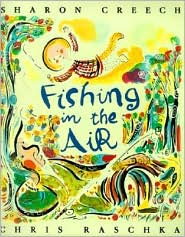
Fishing in the Air

Fishing in the Air
Written by: Sharon Creech
Illustrated by: Chris Raschka
Published by: Joanna Cutler Books 2000
Grades: K-3
Genre: Picture Book, Fiction, Poetry


Synopsis: This book is about a boy and his father who get up early to go fishing.  They set off on their trip hoping to “catch the air” and “catch the breeze.”  On their way, the father has his son use his imagination and turn the lamps into moons and the trees into soldiers.  At the river, the child “fishes” out of his father’s childhood:  finding out about his little gray house and its surroundings of green fields and a clear creek where he learned to fish.  At the end of the day, the father and son have not caught any fish, but they have caught so much more through the memories and the day and he has learned how to fish in the air like his dad. 
Theme/Skill: Fishing, Family, Imagination, Diversity.


About the Author: Sharon Creech

Sharon was born in South Euclid, Ohio and grew up surrounded by her sister and three brothers.  She often visited Quincy, Kentucky where her cousins lived.  This place that contained a farm with hills and trees helped her create many of her books including Walk Two Moons and Chasing Redbird and Bloomability.  In college, she took literature and writing courses which made her curious about story-telling.  She became a high school English and writing teacher in England and Switzerland.  Since then she has written adult novels and children’s literature.  Her first book published in the United States was Walk Two Moons which received the Newbery Medal.  She is currently married to Lyle Rigg and has two children, Rob and Karin. 


Pre-Reading Activities: In order to catch a fish, you need to use a fishing pole.  Start a discussion about fishing while letting the class look at the fishing pole you brought in.  Then show the class the cover and have them tell you what they think the story is about.  Then discuss with the class how and why people fish.  Some do it for recreation while others fish for something to eat.  Ask questions such as:  Have you ever been fishing?  Where you do you fish?  Have you ever caught anything?  Who do you go with?  Then explain that when you are fishing you may see different objects in the sky using your imagination.  Put on the board different cloud forms that can be interpreted into different objects and ask the kids what they think it is. 

For example clouds in the shape of animals:


Post-Reading Activities:  Talk about what the child found out about his house and what it looked like around it.  Then, have the children draw a picture of their house and the things that surround it.  Then, at home, have them ask their parents what their house looked like when they were little.  The children should draw what is described and bring it to the class to explain to everyone. 

Reflection:  I love the imagination this book brings out in students.  I think that it will give students more confidence in participating in class because images they see in pictures will not have any wrong answers because it is everyone's own opinion.  I think that the post-reading activity will also help children learn about what their families childhood was like and what they grew up in or with.  It will help them find out more about their parents and may help make them closer.  It helps show them what connects them to their family and will make them feel important when they share this information with their classmates.

Chicka Chicka Boom Boom

Chicka Chicka Boom Boom
Written by: Bill Martin Jr. and John Archambault
Illustrated by: Lois Ehlert
Published by: Simon & Schuster 1989
Grades: K-1
Genre: Picture Book, Educational
Boston Globe/ Horn Book Honor

Synopsis:  This picture book tells the story of the letters of the alphabet and their encounter with a coconut tree.  There is a race between the letters to the top of the coconut tree. The letters are introduced and described in alphabetical order.  As the first letters go to the tree, the other letters follow suit and want to do the same.  There is always the question of there being enough room and putting too much weigh on the tree.  In the end the tree drops the letters, leaving them upside down.
Theme/Skill: Alphabet, Phonemic Awareness, Repetition, Rhyming.

About the Authors: Bill Martin Jr. and John Archambault

Bill Martin Jr.

Bill was born and raised in Kansas.  He graduated from Emporia State University in Kansas with a teaching degree.  He taught in Kansas and was an elementary school principal in Chicago.  In 1961, he started to develop the literature-based reading programs Sounds of Language and The Instant Readers for Holt, Rinehart, and Winston in New York City.  Bill Martin Jr. wrote for almost 60 years and published more than 300 children’s books.  His first book he ever published was The Little Squeegy Bug-The Story of the Firefly in 1945.  He is the author of many classic books including Brown Bear, Brown Bear, What Do You See? , Polar Bear, Polar Bear, What do you Hear?, The Ghost-Eye Tree, Barn Dance, Chicka Chicka Boom Boom, and Swish.  Bill Martin Jr. lived in Texas when he passed away in 2004.  He is known today as one of America’s favorite children’s author.

Source used:
http://www.billmartinjr.com/bill_martin


                                     John Archambault

John was an eager reader and writer as a child and was inspired by the book Charlotte’s Web.  His writing career started in high school when he had a job at a local newspaper part time.  He soon became a full-time reporter.  He graduated from the University of California at Riverside.  Archambault has authored and co-authored over 20 books.  He has worked side-by-side with Bill Martin Jr. on a variety of projects including  the creation of a supplemental reading program called the Sounds of Language.  The first book they co-authored was The Ghost-Eye Tree.  They have also written Barn Dance!, Knots on a Counting Rope, and White Dynamite and Curly Kidd.  He is developing a series of Big Books for Childcraft Education Corporation to help develop fluency and intuitive associations with print for developing readers.  In these Big Books he is incorporating CDs with read-along and sing-along versions to engage and make reading more fun.  He is now known today as a children’s book author, poet, storyteller, and musician.  He currently lives in Yorba Linda, California with his two sons, Arie and Kevin.


Source used: http://www.johnarchambault.com/about.html

Pre-Reading Activities: Bring in a small tree and hang the letters of the alphabet on it.  Each of the children will come up and take one letter off the tree.  After this ask such questions as: What letters are left on the tree? What letters did you take off the tree? Why do you think the letters are on the tree?  Have the children come up with a word that goes with their letter and write it on the board or dictate it to the teacher. 

Post-Reading Activities:  Looking at the words in the book that describe the letters, see how they are different from what the children came up with.  Ask such questions as: Why do you think we are putting the word blue with the letter “B” and the letter “C” with the word color?  Then after discussing this, have the students make their own letter out of paper and attach a word to it off of the list of words from the pre-reading activity.  Then have them place the letters on the tree that will stay in the classroom.

Ideas to use in the classroom:
http://littlegiraffes.com/teaching-ideas/123/chicka-chicka-boom-boom-activities/

Reflection:  I think that Chicka Chicka Boom Boom is such a classic book that it will be used by numerous teachers for many years to come.  It is such an engaging story that gives alphabet leters some characters.  It allows early readers who are just starting to learn their letters along with sounding out words a book to follow along with and learn the letters.  It gives such a simple concept of letters going up a tree more complex ideas to expand upon such as cause and effect, the descriptions given to the letters, and the identification of letters with children.  There are many engaging lesson plans teachers can use from this that will make if fun for children.  The repetition of the Chicka Chicka Boom Boom will also help students who are unfamiliar with their letters still to participate in reading the book and chanting. 

Tuesday, November 15, 2011

Red Sings from Treetops: A Year in Colors

Red Sings from the Treetops
Written by: Joyce Sidman
Illustrated by: Pamela Zagarenski
Published by: Houghton Mifflin Harcourt 2009
Grades: PK-2
Genre: Picture Book, Poetry
Caldecott Honor Book

Synopsis: This book travels through each season and describes the colors that you see throughout it. It starts with spring and ends full circle with spring again with the color red. In this book, it associates spring with red and the red cardinals that appear singing and the buds of the leaves too. It talks about the green that covers the earth on the trees and in the grass. It talks about birds being born and how spring is also the new beginning to things. It then leads into summer and talks about yellow and the sun and how it melts everything it touches. It then goes into fall where it talks about green being tired and how brown rises and takes over. It ends in winter when you breathe blue and white traces all over everything. It ends with red and the inclination that spring will be here again with the cardinals singing. This completes the cycle of the seasons.
Theme/Skill: Seasons, Colors, Figurative Language, Poetry, Descriptive Language, Word Recognition
About the Author: Joyce Sidman
Joyce Sidman was born in Connecticut and has three sisters.  Education was an important aspect to her parents and herself as she was growing up.  She began writing in grade school by writing things down that came in her head to help her understand the world.  She discovered her love for poetry in high school from the inspiration of one of her teachers.  She loves using images and metaphors in her poetry to explain her thoughts and feelings.  She has written almost one hundred books, but currently has eleven children’s books that have been published.  Among these are Swirl by Swirl: Spirals in Nature, Dark Emperor, The World According to Dog, and Red Sings from Treetops: A Year in Colors.  The latter book received the Caldecott Honor in 2010.  She currently lives in Minnesota with her husband and two sons. 

Source used: http://www.joycesidman.com/biography.html

About the Illustrator:  Pamela Zagarenski
Pamela Zagarenski  graduated from the University of Connecticut with a BFA in Graphic Design.  She is well known as a published illustrator of thirteen children’s books.  Among these books are What Day Is It?/ Que Dia Es?, This Is Just to Say: Poems of Apology and Forgiveness, Mites to Mastodons: A Book of Animal Poems, Small and Large, and Red sings from Treetops: A Year in Colors.   Pamela is also known for her paintings that are on display in the Whyevernot Gallery in Mystic.  She currently lives in Stonington, Connecticut. 


Pre-reading Activities: Activating Prior Knowledge:  Break the students up into four gropus.  In their groups, give students a piece of chart paper, markers, colored pencils, and crayons.  Each group will receive a season as their topic: fall, winter, spring, or summer.  Tell students that their job in the group is to come up with a scene that represents the season their group was given.  When they are done, they need to present it to the rest of the class and explain why they chose the colors they did. 

Post-Reading Activities:  Following reading the book, students will again take their season that they had in the pre-reading activity.  Each student will create their own poem about the season they had first.  They can use the same picture from their chart to help write their poem or create another picture that they will use to describe their poem.  In their poem they must include at least two colors.  These colors must use the same strategy as in the book and have them highlighted in their color.  The poems must be at least 5-7 lines.  Students will have time to start these in class.  If they do not finish in the class time they will take them home to finish and bring them back the next day.  Students will then share them with a partner and have them edit their poem or give them ideas on how to fix them.  After this is done, they will then write a final draft and place it on the final paper with their picture.  They will share it with the class and then each poem will be used to create a class season poem book to put in the reading area. 


Reflection:  I think this book allows children to learn about the seasons both visually and auditorally. It not only allows children to learn their seasons but also their colors. While following along it writes the name of the color in that color. The pages make the color it speaks about pop out and allows children to pick out the different things the story is talking about. I think this book is especially good for visual learners who need pictures in front of them to be able to understand what the teacher is talking about. The rhythm of the book makes a nice read and easy for children to follow along. The book is lengthier than others but using intonation and questions throughout the story should keep students engaged throughout the entire story.

Sunday, November 13, 2011

If You Give A Mouse A Cookie

If You Give a Mouse a Cookie
Written by: Laura Numeroff
Illustrated by: Felicia Bond
Published by: Scholastics Inc. 1985
 
Grades: Pre-K -3
Genre: Picture Book, Comedy

Synopsis: This book tells that story about what will happen if you give a mouse a cookie.  In this book, a boy gives a mouse a cookie which starts off a chain of actions. The mouse then asks for milk and a series of requests begins.  The boy grants the mouse's wishes everytime.  At the end of the story  after many activities, the boy and the mouse end up enjoying a cookie together. 
Theme/Skill: Friendship, Sharing, Kindness, Charity, and Wants and Needs.  It shows that every action has a consequence.  It uses sequencing, icrucluar reasoning, and cause and effect relationship. 

About the Author: Laura Numeroff   Laura was born in Brooklyn, New York in 1953. As she was growing up, she was surrounded by art, music and books.She was a Girl Scout as a child and loved reading, drawing, and making up stories. Instead of going to school to become a writer, she decided to follow in her sister’s footsteps and go to Pratt Institute in Brooklyn to be a fashion designer.In her last semester she took a class in writing and illustrating children’s books.As a result, she graduated from college with a contract for her first book to be published by Macmillan.She has nine books that are published including Beatrice Doesn’t Want To, What Mommies Do Best, What Daddies Do Best, and If You Give A Mouse A Cookie.She currently lives in Los Angeles, California.


Pre-Reading Activities:  Bring in the materials to make a peanut butter and jelly sandwich.  Play the song “Peanut Butter and Jelly.”  After listening have the class explain how to make it.  Questions to ask include: What order are things done to make a peanut butter and jelly sandwich?  How did you know this?  Talk about the order and sequence of this.  Group the children and hand them each sequence cards of how to make it.  Have them put in order the sequence cards. 


Post-Reading Activities:  After reading, ask questions such as:  What was the order that things were done? How could you predict what was going to happen next?  Then as a whole group, have sequence cards again from the book and have the class put them in the correct order of when it occurred.  Then have the class return to their same groups from the pre-reading activity.  Give each group a scenario and have them predict 2-4 steps after that scenario that could happen.  Have them write down the order and draw pictures to go along with it.  They will then share this with the class.   

Reflection: This book is a classic favorite of many children. I love how it is a simple story that articulates a lot of concepts that teachers can use in the classroom. Not only does it engage children through the illustrations and words, but it allows teachers to come up with a variety of activites that will teach them cause and effect. I would definately use this in my classroom to use as a starter for cause and effect. Once I knew children could understand the content from this book, then I could use more difficult books with the class. I could also use her book If You Give A Pig a Pancake after this book, if I think they would need a little more help with cause and effect. 

Additional ideas to use in the classroom: http://lauranumeroff.com/teachers/story_starters.htm
http://webapps.monroe.edu/technologyservices/multimedia/guides/3322a.pdf

I Love You, Bunny Rabbit

I Love You, Bunny Rabbit
Written by: Shulamith Levey Oppenheim
Illustrated by:
Cyd Moore
Published by: Boyds Mill Press 1995

Grades: K-2
Genre: Picture Book, Realistic Fiction

Synopsis: This book is a story about Micah’s rabbit called Bunny Rabbit. Micah’s rabbit is very dirty and old. Bunny Rabbit has been through so much that she has no fur, has applesauce and chocolate milk all over her, and has been chewed extensively.As a result, his mom says that it is time to buy a new stuffed rabbit. He goes into the toy store, but nothing convinces him or appeals to him to buy a new one.Micah loves it so much just the way it is that his mother lets him keep it. 
Theme:  Attachment, Love, Family and Relationships, Friendship, Toys, Social Acceptance.

About the Author: Shulamith Levey Oppenheim
   

Growing up in her house, books were everywhere to be found.  She was read to extensively by her parents which also gave her a deep respect for books.  During her teenage years, she read many adult literature novels and poems.  She never dreamt of becoming a writer until she was influenced by another author.  She has written books including, Rescuing Eintsein’s Compass, The Seaking, Yanni Rubbish, The Fish Prince, and many more.  She lives in Amherst, Massachusetts with her husband, Felix.  She has three children and five grandchildren.   

Pre-Reading Activities:  Prior to the day, send home a note to the parents to have children send in something they really enjoy.  The parents will be asked to help their children write three riddles for it and a reason that they like it so much.  Then on that day, the teacher will also bring in something that they really like, such as a bunny.  The teacher will model how the activity will go by having children give three guesses of what it could be.  If they don’t get it then they will have to reveal one of their riddles.  Children will raise their hands to guess again.  This will continue until all riddles are read and then the item revealed.  The teacher will reveal also the reason they like it so much.  Each student will then have a turn to do this. 

Post-Reading Activities:  After reading, ask questions such as: How would you feel if your item was taken away from you? Why would you feel like this? How would you explain your feelings to somebody else? Then have children draw a picture of their item they brought in.  Depending on their ability, students will write a word or sentence about their item.  These pictures will be collected and put together into a class book or onto a bulletin board for everyone to see.  They will be kept as records of students writing progress throughout the year.

Reflection:  I like how this book relates so well to little children. It hits on things that many little kids go through, having an attachment to some toy, blanket, or person that they do just not want to part with no matter how dirty or torn it may get. It helps children logically cope with things that may occur in their life. The illustrations of different size and shapes helps draw in the reader through the artwork. I think this is a good book to use to help children understand events they may go through in life in the most simplistic way that is possible.